
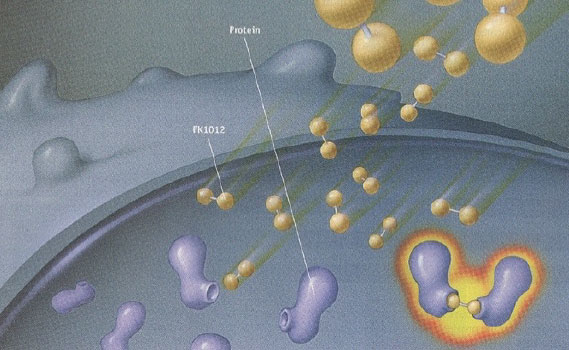
Chemically Induced Proximity (CIP) in Biology and Medicine: The Importance of Being Close. Several years ago, working with Stuart Schreiber (pictured below), we developed bifunctional small molecules to explore the role of proximity in biology1. These molecules (such as FK1012) get through the cell membrane and bind to small protein tags that we could add to a protein of interest and simply bring the tagged proteins close to one another as dimers or oligomers as illustrated below on the right. These studies revealed that induced proximity was a fundamental biophysical principal used by many membrane receptors1-6 kinases7, exchange factors8, transcription factors9 and epigenetic regulators10-15. The realization that chemically induced proximity (CIP) to E3 ligases and then to the proteosome was central to controling protein degradation led our lab to collaborate with Martin Prushy, in Stuart’s lab, to develop bifunctional degraders. Martin’s lab mate Craig Crews extended the concept after starting his own lab at Yale to develop PROTACs16. Further development by Criag and his colleagues has blossomed into a major new field. Protein stabilization17 and localization18 could also be easily controlled by CIP, In addition, we were able to show that post translational modifications such as phosphorylation or methylation often produced their effects by induced proximity10. These studies laid the foundation for development of investigative tools and therapeutics that function by induced proximity.
Development of Chemical Inducers of Proximity:

 Featured in:
- New York Times, 1993
- Discovery Magazine, 1994
- New York Times, 1996
- Wall Street Journal, 1998
- Science, 2018
- New York Times 2023
Epigenetic and transcriptional regulation were particularly informative examples of induced proximity. We made strains of mice (which we called the Chromatin in vivo Assay or CA mice), in which we could use CIP to recruit critical chromatin and epigenetic regulators to specific genetic loci and then measure the minute-by-minute biochemical consequences10,14. Simon Braun in the lab, extended these techniques to any genetic locus in a living mouse by CRISPR-facilitated recruitment19. Oli Bell and Nathanael Hathaway were able to induce spreading repression by recreating Position Effect Variation at the Oct4 locus10 and measure its speed along the chromosome10,20. In cells from the CIA mice we could activate ATP-dependent remodeling complexes and rapidly reverse Polycomb repression thereby providing a molecular understanding of the long mysterious opposition between Trithorax and Polycomb13,14. Emma Chory (now at Duke University) used this system to demonstrate that the turnover of modified nucleosomes by ATP-dependent chromatin remodels is a general means of propagation of epigenetic marks and a determinant of methylation valence12,21. Indeed, most aspects of epigenetic and transcriptional regulation could be produced by CIP21. These were proof-of-concept experiments for our later development of therapeutics for a variety of human diseases (see next section).
At a practical level, the demonstration that CIP of T cell receptor zeta chain could be used to activate T cells contributed to the development of Chimeric Antigen Receptors for CAR-T therapy1. Furthermore, the discovery that the FAS receptor and caspases were activated by induced proximity using FK1012 or rimiducid by David Spencer in our lab and Pete Belshaw in Stuart’s lab led to the development of safety switches for CAR-T therapy2-4,6. Finally, modulation of the binding affinity of target proteins by CIP, first developed by Roger Briesewitz in our lab22 is now being used to make better ras inhibitors23-26, which are presently in clinical trials27. The Briesewitz approach of affinity modulation by CIP has also led to the development of inhibitors of protein interactions with transcription factors, for example with RIPTACs, which are a subclass of TCIPs28-30 that inhibit their targets31. Presently there are many drugs under clinical trial that make use of the fundamental mechanism of induced proximity and most major pharmaceutical companies have therapeutic programs using induced proximity with small bifunctional molecules.